August 19, 2016

Knowing Your Rights As A Shareholder

Common Shareholders' Six Main Rights

1. Voting Power on Major Issues
This includes electing directors and proposals for fundamental changes affecting the company such as mergers or liquidation. Voting takes place at the company's annual meeting. If you can't attend, you can do so by proxy and mail in your vote.

2. Ownership in a Portion of the Company
However, when business thrives, common shareholders own a piece of something that has value. Said another way, they have a claim on a portion of the assets owned by the company. As these assets generate profits, and as the profits are reinvested in additional assets, shareholders see a return in the form of increased share value as stock prices rise.

3.The Right to Transfer Ownership 

Right to transfer ownership means shareholders are allowed to trade their stock on an exchange. The right to transfer ownership might seem mundane, but the liquidity provided by stock exchanges is extremely important. Liquidity is one of the key factors that differentiates stocks from an investment like real estate. If you own property, it can take months to convert your investment into cash. Because stocks are so liquid, you can move your money into other places almost instantaneously.


4.An Entitlement to Dividends

Along with a claim on assets, you also receive a claim on any profits a company pays out in the form of a dividend. Management of a company essentially has two options with profits: they can be reinvested back into the firm (hopefully increasing the company's overall value) or paid out in the form of a dividend. You don't have a say in what percentage of profits should be paid out - this is decided by the board of directors. However, whenever dividends are declared, common shareholders are entitled to receive their share. (To continue reading, see How and Why Do Companies Pay Dividends?)

5. Opportunity to Inspect Corporate Books and Records

This opportunity is provided through a company's public filings, including its annual report. Nowadays, this isn't such a big deal as public companies are required to make their financials public. It can be more important for private companies.

6. The Right to Sue for Wrongful Acts 

Suing a company usually takes the form of a shareholder class-action lawsuit. A good example of this type of suit occurred in the wake of the accounting scandal that rocked WorldCom in 2002, after it was discovered that the company had grossly overstated earnings, giving shareholders and investors an erroneous view of its financial health. The telecom giant faced a firestorm of shareholder class-action suits as a result. (Want to read more about frauds? See The Biggest Stock Scams of All Time.)
Shareholder rights vary from state to state, and country to country, so it is important to check with your local authorities and public watchdog groups. In North America, however, shareholders rights tend to be more developed than other nations and are standard for the purchase of any common stock. These rights are crucial for the protection of shareholders against poor management.


April 10, 2016

The Golden Rules For Investing In Equities

1. Be a long term investor
This is the first and most important rule of equity investment. Timing the market - entering the market at low levels and exiting at higher levels - is almost impossible. Though often heard on the street, this strategy is difficult to implement, as it is nearly impossible to gauge when the market has peaked and when it has bottomed out. Do not play the guessing game; it is more sensible to put money into the market with a long term commitment.

Trading or speculating seldom helps in equities. You could make quick bucks by trading in 10 deals, but you could lose whatever you have earned in just one deal. This is the risk you take when you try to trade and make easy money from the stock market. Apart from incurring financial losses, it also involves a lot of mental stress. Trading could give you sleepless nights.

Globally, economies follow seven year business cycles of boom and bust. Thus, when you are investing, invest for a fairly long term, say three to seven years. Indeed, it is a proven fact that over the long haul, equities tend to outperform all other asset classes.


2. Invest time and efforts in doing your homework
Investing in equities is not a one time affair. You need to invest a lot of time and efforts, apart from money, to understand industries, economic trends and so on. Further, you should dedicate time to analyse companies, as this will help you to avoid costly mistakes. You need to develop the habit of reading first hand information - such as company annual reports, company announcements and so on. Annual reports of large companies are easily available on the web. Reading business dailies is also a must for equity investors.

Get your basic concepts and fundamentals right. Revisiting financial fundamentals periodically would be a good idea. You need to understand basic concepts like the Price-Earning ratio (P/E ratio), operating margins, earnings per share, etc. Analysing balance sheets and profit and loss accounts is a must. A short term course on ratio analysis would be of immense help.

Further, understand technicalities of investment, like how the stock market operates, how to buy or sell, settlement procedures, etc.

Also focus on domestic economic and policy development. These factors are also of immense importance as they lead to structural changes in the economy that would benefit certain industries. For instance, the boom in the telecom sector in the domestic market is driven by government policy initiatives over the years.

Lastly, you also need to keep yourself abreast with key global developments. With liberalisation and subsequent integration of economies, global factors also impact domestic industries and the stock market.

The stock market is said to be all about sentiments. However, in this mad rush you need to stay focused and maintain a lot of discipline in executing your investment strategy. Thus, irrespective of which way the market moves, you need to stick to your investment strategy without getting swayed by market sentiments.

In short, discipline in your investment approach will protect you from the herd mentality. Most investors are tempted to buy when everyone is on a buying binge and sell when the market is moving southwards. But if you have decided as a rule to buy a particular stock only when the overall market corrects by one per cent, this rule could kill your temptation to jump on the stock when the market is overheated.

3. Pay the right price
It is essential to buy at the ‘right price’, that is, the price that you are comfortable paying. Do not buy because others are doing so. This will help you to hold the stock for a longer duration.

Conversely, when you have to decide when to sell, if you feel that the market is overheated and prices have reached unrealistic levels, exit; Don’t stick on hoping for a little more. It helps to limit your own greed.

4. Portfolio diversification
Diversion is a very old and popular investment strategy, applied to reduce portfolio risk. Actually, before you start investing in equities, you should consider various factors like your age, monetary requirements, etc, to determine how much risk you can take on. For instance, if you are around 30 years old, you can invest a greater portion of your portfolio in equities than a retired person. Once you have determined how much risk you can take on and how much you can invest regularly in equities, try to achieve diversification in your portfolio.

To reduce risk, diversify within equities by investing across sectors. Do not invest in one or two sectors or any negative development pertaining to those sectors could severely impact the profitability of your portfolio.

Secondly, ensure a good blend of small, mid and large-cap stocks in your portfolio. While large cap stocks would lend stability to your portfolio, small and mid cap stocks would give you an above average appreciation. Basically, growth potentials are higher in the case of small and mid cap stocks. Thus, just having large cap stocks could be safe but also mean that returns are just about at the same level as market returns.

Thirdly, invest across value and growth stocks. Growth stocks are risky but also offer higher returns while value stocks are likely to be less volatile.

In brief, when you spread your investments over a larger number of stocks and sectors, if a few stocks/sectors under-perform, this is compensated by other stocks/sectors which perform well.

5. Do not buy on tips or rumors rather focus on fundamentals
Tips and rumors are an integral part of the stock market. Always remember that these could be engineered by a group of traders or punters. Therefore, a sharp rally based on rumors could fizzle out in a short time.

You should strictly stay away from rumors, suggestions or tips received from your broker or friends or the investor circle. Investments based on tips could lead to huge losses. Rather, you would be better off investing based on industry and company fundamentals. Furthermore, generally such tips pertain to small and mid cap stocks, where liquidity is extremely limited. If you invest in such stocks, you could get trapped in an illiquid investment for a very long time.


6. Buy shares of companies whose business you understand
In the long run, the stock market rewards companies with strong fundamentals and good financial performance. Therefore, it is essential for you to invest in companies whose industry dynamics and business models you understand. This will help you to gauge whether a transformation in an industry is positive or negative, at an early stage itself, and its likely impact on the company’s fundamentals. Your understanding of industry dynamics would help you to evaluate industry trends.

7. Don’t sell in panic
Markets go through cycles of boom and bust and volatility is a way of life in equities. Do not sell your holdings in a hurry and panic just because your stocks have witnessed a sudden correction. Always focus on company fundamentals; if they are intact, there’s nothing to worry about.

8. Do not borrow money to invest in equities
It is true that equities tend to outperform other investment avenues in the long run. However, there is no guarantee that you will make money on your stocks either in terms of dividends or capital gains, if your sale of shares is time-bound. Therefore, if you borrow funds to invest in equities, it might be difficult for you to repay the interest or principal on the loan, on time.

What really matters in equity investment is your withholding power. So, invest your surplus money in equities and only invest an amount that you will not need in the immediate future. If you borrow and invest, your withholding power to stay invested for the long term could be limited.

9. Do not marry a stock
If you feel your investment decision has gone wrong, exit the counter; don’t try to average. It is prudent to cut losses, rather than lower the average purchase price. Particularly in cases where the stock is witnessing a continuous sell-off, it is better to offload your position and book losses. You can use the same money to invest in other opportunities.

10. Invest regularly and gradually build up your position
Just as you put money into fixed interest bearing investments regularly, also invest in equities on a periodic basis. Further, do not invest at one go. Rather, buy on a regular basis and in small lots. This will help you to buy stocks at a reasonable price.


11. Monitor your portfolio
Investing in equity is not a one time affair. Buying shares is perhaps the smallest part of the overall investment activity. It is important to periodically monitor and review your investment portfolio. It is always prudent to sell a stock if you feel that the fundamentals have deteriorated and the stock is overpriced in comparison to its fair value. Money has an opportunity cost and by selling an overvalued stock you can investment the same money elsewhere, for better capital appreciation opportunities.

April 9, 2016

P/E Ratio: What Is It?


P/E is short for the ratio of a company's share price to its per-share earnings. As the name implies, to calculate the P/E, you simply take the current stock price of a company and divide by its earnings per share (EPS):

P/E Ratio =market value per Share
 Earning per share (EPS)


Earnings per Share (EPS)

Most of the time, the P/E is calculated using EPS from the last four quarters. This is also known as the trailing P/E. However, occasionally the EPS figure comes from estimated earnings expected over the next four quarters. This is known as the leading or projected P/E. A third variation that is also sometimes seen uses the EPS of the past two quarters and estimates of the next two quarters.

There isn't a huge difference between these variations. But it is important to realize that in the first calculation, you are using actual historical data. The other two calculations are based on analyst estimates that are not always perfect or precise.

Companies that aren't profitable, and consequently have a negative EPS, pose a challenge when it comes to calculating their P/E. Opinions vary on how to deal with this. Some say there is a negative P/E, others give a P/E of 0, while most just say the P/E doesn't exist.

Historically, the average P/E ratio in the market has been around 15-25. This fluctuates significantly depending on economic conditions. The P/E can also vary widely between different companies and industries.

How to Read A Stock Table/Quote


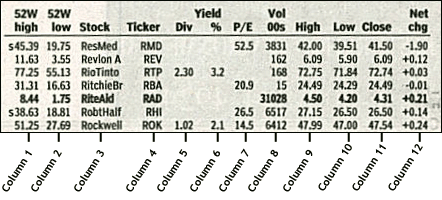
Any financial paper has stock quotes that will look something like the image below:


Columns 1 & 2: 52-Week High and Low - These are the highest and lowest prices at which a stock has traded over the previous 52 weeks (one year). This typically does not include the previous day's trading.

Column 3: Company Name & Type of Stock - This column lists the name of the company. If there are no special symbols or letters following the name, it is common stock. Different symbols imply different classes of shares. For example, "pf" means the shares are preferred stock.

Column 4: Ticker Symbol - This is the unique alphabetic name which identifies the stock. If you watch financial TV, you have seen the ticker tape move across the screen, quoting the latest prices alongside this symbol. If you are looking for stock quotes online, you always search for a company by the ticker symbol. If you don't know what a particular company's ticker is you can search for it at: http://finance.yahoo.com/l.

Column 5: Dividend Per Share - This indicates the annual dividend payment per share. If this space is blank, the company does not currently pay out dividends.

Column 6: Dividend Yield - The percentage return on the dividend. Calculated as annual dividends per share divided by price per share.

Column 7: Price/Earnings Ratio - This is calculated by dividing the current stock price by earnings per share from the last four quarters. For more detail on how to interpret this, see our P/E Ratio tutorial.


Column 8: Trading Volume - This figure shows the total number of shares traded for the day, listed in hundreds. To get the actual number traded, add "00" to the end of the number listed.

Column 9 & 10: Day High and Low - This indicates the price range at which the stock has traded at throughout the day. In other words, these are the maximum and the minimum prices that people have paid for the stock.

Column 11: Close - The close is the last trading price recorded when the market closed on the day. If the closing price is up or down more than 5% than the previous day's close, the entire listing for that stock is bold-faced. Keep in mind, you are not guaranteed to get this price if you buy the stock the next day because the price is constantly changing (even after the exchange is closed for the day). The close is merely an indicator of past performance and except in extreme circumstances serves as a ballpark of what you should expect to pay.

Column 12: Net Change - This is the dollar value change in the stock price from the previous day's closing price. When you hear about a stock being "up for the day," it means the net change was positive.

Quotes on the Internet 
Nowadays, it's far more convenient for most to get stock quotes off the Internet. This method is superior because most sites update throughout the day and give you more information, news, charting, research, etc. 

What Causes Stock Prices To Change?

Stock prices change every day as a result of market forces. By this we mean that share prices change because of supply and demand. If more people want to buy a stock (demand) than sell it (supply), then the price moves up. Conversely, if more people wanted to sell a stock than buy it, there would be greater supply than demand, and the price would fall.

Understanding supply and demand is easy. What is difficult to comprehend is what makes people like a particular stock and dislike another stock. This comes down to figuring out what news is positive for a company and what news is negative. There are many answers to this problem and just about any investor you ask has their own ideas and strategies.

That being said, the principal theory is that the price movement of a stock indicates what investors feel a company is worth. Don't equate a company's value with the stock price. The value of a company is its market capitalization, which is the stock price multiplied by the number of shares outstanding. For example, a company that trades at $100 per share and has 1 million shares outstanding has a lesser value than a company that trades at $50 that has 5 million shares outstanding ($100 x 1 million = $100 million while $50 x 5 million = $250 million). To further complicate things, the price of a stock doesn't only reflect a company's current value, it also reflects the growth that investors expect in the future.


The most important factor that affects the value of a company is its earnings. Earnings are the profit a company makes, and in the long run no company can survive without them. It makes sense when you think about it. If a company never makes money, it isn't going to stay in business. Public companies are required to report their earnings four times a year (once each quarter). Wall Street watches with rabid attention at these times, which are referred to as earnings seasons. The reason behind this is that analysts base their future value of a company on their earnings projection. If a company's results surprise (are better than expected), the price jumps up. If a company's results disappoint (are worse than expected), then the price will fall.

Of course, it's not just earnings that can change the sentiment towards a stock (which, in turn, changes its price). It would be a rather simple world if this were the case! During the dotcom bubble, for example, dozens of internet companies rose to have market capitalizations in the billions of dollars without ever making even the smallest profit. As we all know, these valuations did not hold, and most internet companies saw their values shrink to a fraction of their highs. Still, the fact that prices did move that much demonstrates that there are factors other than current earnings that influence stocks. Investors have developed literally hundreds of these variables, ratios and indicators. Some you may have already heard of, such as the price/earnings ratio, while others are extremely complicated and obscure with names like Chaikin oscillator or moving average convergence divergence.

So, why do stock prices change? The best answer is that nobody really knows for sure. Some believe that it isn't possible to predict how stock prices will change, while others think that by drawing charts and looking at past price movements, you can determine when to buy and sell. The only thing we do know is that stocks are volatile and can change in price extremely rapidly.


The important things to grasp about this subject are the following:

1. At the most fundamental level, supply and demand in the market determines stock price.
2. Price times the number of shares outstanding (market capitalization) is the value of a company. Comparing just the share price of two companies is meaningless.
3. Theoretically, earnings are what affect investors' valuation of a company, but there are other indicators that investors use to predict stock price. Remember, it is investors' sentiments, attitudes and expectations that ultimately affect stock prices.
4. There are many theories that try to explain the way stock prices move the way they do. Unfortunately, there is no one theory that can explain everything.

September 13, 2008

What is Option?

In Global Financial Markets, for many years, options have been a means of conveying rights
from one party to another at a specified price on or before a specific date. Options to buy and sell
are commonly executed in real estate and equipment transactions, just as they have been for
years in the securities markets. There are two types of option agreements:

CALLS and PUTS.
• A CALL OPTION is a contract that conveys to the owner the right, but not theobligation, to purchase a prescribed number of shares or futures contracts of an
underlying security at a specified price before or on a specific expiration date.

• A PUT OPTION is a contract that conveys to the owner the right, but not obligation, to
sell a prescribed number of shares or futures contracts of an underlying security at a
specified price before or on a specific expiration date.

Consequently, if the market in a security were expected to advance, a trader would purchase a
call and, conversely, if the market in a security were expected to decline, a trader would purchase

a put. With the advent of listed options, the inconvenience and difficulties originally associated
with transacting options have been greatly diminished.


What are futures?

Futures and options represent two of the most common form of "Derivatives". Derivatives are financial instruments that derive their value from an 'underlying'

Futures

A 'Future' is a contract to buy or sell the underlying asset for a specific price at a pre-determined time. If you buy a futures contract, it means that you promise to pay the price of the asset at a specified time. If you sell a future, you effectively make a promise to transfer the asset to the buyer of the future at a specified price at a particular time. Every futures contract has the following features:
  • Buyer
  • Seller
  • Price
  • Expiry

Some of the most popular assets on which futures contracts are available are equity stocks, indices, commodities and currency.

The difference between the price of the underlying asset in the spot market and the futures market is called 'Basis'. (As 'spot market' is a market for immediate delivery) The basis is usually negative, which means that the price of the asset in the futures market is more than the price in the spot market. This is because of the interest cost, storage cost, insurance premium etc., That is, if you buy the asset in the spot market, you will be incurring all these expenses, which are not needed if you buy a futures contract. This condition of basis being negative is called as 'Contango'.

Sometimes it is more profitable to hold the asset in physical form than in the form of futures. For eg: if you hold equity shares in your account you will receive dividends, whereas if you hold equity futures you will not be eligible for any dividend.


March 27, 2008

What is a Bull Market ?

There are two classic market types used to characterize the general direction of the market. Bull markets are when the market is generally rising, typically the result of a strong economy. A bull market is typified by generally rising stock prices, high economic growth, and strong investor confidence in the economy. Bear markets are the opposite. A bear market is typified by falling stock prices, bad economic news, and low investor confidence in the economy.

bull market is a financial market where prices of instruments (e.g., stocks) are, on average, trending higher. The bull market tends to be associated with rising investor confidence and expectations of further capital gains.


A market in which prices are rising. A market participant who believes prices will move higher is called a "bull". A news item is considered bullish if it is expected to result in higher prices.An advancing trend in stock prices that usually occurs for a time period of months or years. Bull markets are generally characterized by high trading volume.

Simply put, bull markets are movements in the stock market in which prices are rising and the consensus is that prices will continue moving upward. During this time, economic production is high, jobs are plentiful and inflation is low. Bear markets are the opposite--stock prices are falling, and the view is that they will continue falling. The economy will slow down, coupled with a rise in unemployment and inflation.


A key to successful investing during a bull market is to take advantage of the rising prices. For most, this means buying securities early, watching them rise in value and then selling them when they reach a high. However, as simple as it sounds, this practice involves timing the market. Since no one knows exactly when the market will begin its climb or reach its peak, virtually no one can time the market perfectly. Investors often attempt to buy securities as they demonstrate a strong and steady rise and sell them as the market begins a strong move downward.
                                                 
Portfolios with larger percentages of stocks can work well when the market is moving upward. Investors who believe in watching the market will buy and sell accordingly to change their portfolios.Speculators and risk-takers can fare relatively well in bull markets. They believe they can make profits from rising prices, so they buy stocks, options, futures and currencies they believe will gain value. Growth is what most bull investors seek.

What is a Bear Market?

The opposite of a bull market is a bear market when prices are falling in a financial market for a prolonged period of time. A bear market tends to be accompanied by widespread pessimism.A bear market is slang for when stock prices have decreased for an extended period of time. If an investor is "bearish" they are referred to as a bear because they believe a particular company, industry, sector, or market in general is going to go down.

HOW STOCK MARKET WORKS ?

In order to understand what stocks are and how stock markets work, we need to dive into history--specifically, the history of what has come to be known as the corporation, or sometimes the limited liability company (LLC). Corporations in one form or another have been around ever since one guy convinced a few others to pool their resources for mutual benefit.

The first corporate charters were created in Britain as early as the sixteenth century, but these were generally what we might think of today as a public corporation owned by the government, like the postal service. 

Privately owned corporations came into being gradually during the early 19th century in the United States , United Kingdom and western Europe as the governments of those countries started allowing anyone to create corporations.


In order for a corporation to do business, it needs to get money from somewhere. Typically, one or more people contribute an initial investment to get the company off the ground. These entrepreneurs may commit some of their own money, but if they don't have enough, they will need to persuade other people, such as venture capital investors or banks, to invest in their business.

They can do this in two ways: by issuing bonds, which are basically a way of selling debt (or taking out a loan, depending on your perspective), or by issuing stock, that is, shares in the ownership of the company.

Long ago stock owners realized that it would be convenient if there were a central place they could go to trade stock with one another, and the public stock exchange was born. Eventually, today's stock markets grew out of these public places.

A corporation is generally entitled to create as many shares as it pleases. Each share is a small piece of ownership. The more shares you own, the more of the company you own, and the more control you have over the company's operations. Companies sometimes issue different classes of shares, which have different privileges associated with them.

So a corporation creates some shares, and sells them to an investor for an agreed upon price, the corporation now has money. In return, the investor has a degree of ownership in the corporation, and can exercise some control over it. The corporation can continue to issue new shares, as long as it can persuade people to buy them. If the company makes a profit, it may decide to plow the money back into the business or use some of it to pay dividends on the shares.

Public Markets

How each stock market works is dependent on its internal organization and government regulation. The NYSE (New York Stock Exchange) is a non-profit corporation, while the NASDAQ (National Association of Securities Dealers Automated Quotation) and the TSE (Toronto Stock Exchange) are for-profit businesses, earning money by providing trading services.

Most companies that go public have been around for at least a little while. Going public gives the company an opportunity for a potentially huge capital infusion, since millions of investors can now easily purchase shares. It also exposes the corporation to stricter regulatory control by government regulators.

When a corporation decides to go public, after filing the necessary paperwork with the government and with the exchange it has chosen, it makes an initial public offering (IPO). The company will decide how many shares to issue on the public market and the price it wants to sell them for. When all the shares in the IPO are sold, the company can use the proceeds to invest in the business.

March 14, 2008

How to make investment decisions?

The stock market has, perhaps, the most exciting investment opportunities for the investor community. At the same time, it could be unnerving and scary. In fact, equity investment has always remained a big challenge, not only for retail but institutional investors, too. Moreover, investors’ discomfort generally increases with a rise in market volatility. You will find many investors entering the market at high levels and making a quick exit as the market witnesses a correction. Unfortunately, such investors seldom think of investing in stocks again. Thus, they ignore an excellent opportunity to earn above average returns.

In short, investing in equities can be a difficult proposition for retail investors. However, equity must form a part of every investor’s portfolio. The proportion could vary, depending on the investor’s age, monetary requirements, risk appetite, etc.

To cope with volatility, it is important to have a disciplined and systematic approach to equity investment. Set your own rules and more importantly, follow them religiously. Indeed, the mantra for successful equity investment is a well thought-out, disciplined investment strategy.

A long-term monetary commitment, adherence to discipline in investment and decisions based on company fundamentals are essential ingredients for successful equity investment.

January 18, 2008

How to start trading

  1. Open a broking account with a registered stock broker. You can also open an internet trading account and start trading by click of a mouse. A large number of brokers such as ICICI Web-trade, Motilal Oswal Securities, Geojit Securities etc. are offering e-broking services.
  2. Submit your details and sign the broker client agreement with your broker. This is mandatory.
  3. Open a Demat account with any of the Depository particiapants registered with NSDL or CDSL. If your broker is also a DP, you can open the DP account with him also. Sign the relevant papers and execute agreement.

    Don't deal with unregistered intermediaries, as this would expose you to counter party risk and may lead to losses without any stock exchange recourse for remedy.
  • Give clear and unambiguous instructions to your Broker / Sub-broker.
  • Keep a record of all instructions issued to the Broker / Sub-broker.
  • Insist on a contract note issued for each day of trading and confirm the details printed therein about your transactions for the day.
  • Don't fall prey to promises of unrealistic high returns. It is easy to lose money that way.

  • Don't indulge in speculative trading, go by fundamentals of accompany and invest for medium to long term.
  • Trade within your predetermined limits and financial capacity.
  • Promptly issue delivery instructions to your DP for transferring the shares sold by you to your broker's account. Failure to do so may result in huge losses for you.
  • Use the Investors' Grievance Redressal system of the stock exchanges and Depository to redress your grievances if any.
  • January 9, 2008

    Trading Strategies

    There are two basic ways to trade the stock market – shooting in the barrel or using strategies to determine which stocks to buy, when to sell, and how to protect your investment dollars. Needless to say, strategies outperform barrel shooting by a large margin. There are, however, hundreds of trading strategies to choose from. Of all of these there are a couple of tried and trued methods that have worked well for investors over many years. The beginning investor is advised to investigate some of these basic strategies and see for himself how they perform. New strategies can be explored once the basic ones are well-understood.

    Hedging
    Hedging is a way of protecting an investment by reducing the risks involved in holding a particular stock. The risk that the price of the stock will drop can be offset by buying a put option that allows you to sell at the stock at a particular price within a certain time frame. If the price of the stock falls, the value of the put option will increase.

    Buying put options against individual stocks is the most expensive hedging strategy. If you have a broad portfolio a better option may be to buy a put option on the stock market itself. This protects you against general market declines. Another way to hedge against market declines is to sell financial futures like the S&P 500 futures.

    Dogs of the Dow

    This is a strategy that became popular during the 1990s. The idea is to buy the best-value stocks in the Dow Industrial Average by choosing the 10 stocks that have the lowest P/E ratios and the highest dividend yields. The companies on the Dow Index are mature companies that offer reliable investment performance. The idea is that the lowest 10 on the Dow have the most potential for growth over the coming year. A new twist on the Dogs of the Dow is the Pigs of the Dow. This strategy selects the worst 5 Dow stocks by looking at the percentage of price decline in the previous year. As with the Dogs, the idea is that the Pigs stand to rebound more than the others.

    Buying on Margin
    Buying on margin means to buy stocks with borrowed money – usually from your broker. Margin gives you more return than if you were to pay the full cost outright because you receive more stock for a lower initial investment. Margin buying can also be risky because if the stock loses value your losses will be correspondingly greater. When buying on margin the investor should have stop-loss orders in place to limit losses in the case of market reversal. The amount of margin should be limited to about 10% of the value of your total account.

    Dollar Cost and Value Averaging
    Dollar cost averaging involves investing a fixed dollar amount on a regular basis. An example would be buying shares of a mutual fund on a monthly basis. If the fund drops in price the investor will receive more shares for his money. Conversely, when the price is higher, the fixed amount will buy fewer shares. An alternative to this is value averaging. The investor decides on a regular value he wishes to invest. For example, he may wish to invest $100 a month in a mutual fund. When the price of the fund is high he puts a higher dollar amount in the fund and when the price is low he spends less money. This averages out his investment to the original $100 per month. Value averaging almost always outperforms dollar cost averaging as a percentage return on the money invested. When used as part of a broader trading strategy it can help secure the growth of your investment fund.

    January 6, 2008

    Some Trading Trick

    General Market Advice:

    1. Never chase a stock.

    2. Buy when markets are in the grip of panic.

    3. Only buy fundamentally strong stocks, which are undervalued.

    4. Buy stocks grown in top line and bottom line over the past years.

    5. Invest in companies with proven management.

    6. Avoid loss-making companies.

    7. PE Ratio and Growth in earnings per share are the key.

    8. Look for the dividend paying record.

    9. Invest in stocks for sure returns.

    10. Stocks have been the high yielding asset class over the past.

    11. Stocks are an asset class.

    12. The basic property of any asset class is to grow.

    13. Buy when everyone is selling and sell when everyone buys.

    14. Invest a fixed amount each month.

    Fundamental Analysis Part Two – Tools

    Although the raw data of the Financial Statement has some useful information, much more can be understood about the value of a stock by applying a variety of tools to the financial data.
    Earnings per Share

    The overall earnings of a company is not in itself a useful indicator of a stock's worth. Low earnings coupled with low outstanding shares can be more valuable than high earnings with a high number of outstanding shares. Earnings per share is much more useful information than earnings by itself. Earnings per share (EPS) is calculated by dividing the net earnings by the number of outstanding shares. For example: ABC company had net earnings of $1 million and 100,000 outstanding shares for an EPS of 10 (1,000,000 / 100,000 = 10). This information is useful for comparing two companies in a certain industry but should not be the deciding factor when choosing stocks.

    Price to Earning Ratio
    The Price to Earning Ratio (P/E) shows the relationship between stock price and company earnings. It is calculated by dividing the share price by the Earnings per Share. In our example above of ABC company the EPS is 10 so if it has a price per share of $50 the P/E is 5 (50 / 10 = 5). The P/E tells you how much investors are willing to pay for that particular company's earnings. P/E's can be read in a variety of ways. A high P/E could mean that the company is overpriced or it could mean that investors expect the company to continue to grow and generate profits. A low P/E could mean that investors are wary of the company or it could indicate a company that most investors have overlooked.

    Either way, further analysis is needed to determine the true value of a particular stock.

    Price to Sales Ratio
    When a company has no earnings, there are other tools available to help investors judge its worth. New companies in particular often have no earnings, but that does not mean they are bad investments. The Price to Sales ratio (P/S) is a useful tool for judging new companies. It is calculated by dividing the market cap (stock price times number of outstanding shares) by total revenues. An alternate method is to divide current share price by sales per share. P/S indicates the value the market places on sales. The lower the P/S the better the value.

    Price to Book Ratio
    Book value is determined by subtracting liabilities from assets. The value of a growing company will always be more than book value because of the potential for future revenue. The price to book ratio (P/B) is the value the market places on the book value of the company. It is calculated by dividing the current price per share by the book value per share (book value / number of outstanding shares). Companies with a low P/B are good value and are often sought after by long term investors who see the potential of such companies.

    Dividend Yield
    Some investors are looking for stocks that can maximize dividend income. Dividend yield is useful for determining the percentage return a company pays in the form of dividends. It is calculated by dividing the annual dividend per share by the stock's price per share. Usually it is the older, well-established companies that pay a higher percentage, and these companies also usually have a more consistent dividend history than younger companies.

    Fundamental Analysis Part One

    The investor has many tools at hand when making decisions about which stocks to buy. One of the most useful of these is fundamental analysis – examining key ratios which show the worth of a stock and how a company is performing.

    The goal of fundamental analysis is to determine how much money a company is making and what kind of earnings can be expected in the future. Although future earnings are always subject to interpretation, a good earning history creates confidence among investors. Stock prices increase and dividends may also be paid out.

    Companies are required to report earnings on a regular basis and stock market analysts examine these figures to determine if a company is meeting its expected growth. If not, there is usually a downturn in the stock's price.

    There are many tools available to help determine a company's earnings and its value on the stock market. Most of them rely on the financial statements provided by the company. Further fundamental analysis can be done to reveal details about the value of a company including its competitive advantages and the ratio of ownership between management and outside investors.

    Financial Statements
    Every publicly traded company must publish regular financial statements. These statements are available in printed form or on the Internet. All statements must include an income statement, a balance sheet, an auditor's report, a statement of cash flow, a description of the business activities and the expected revenue for the coming year.

    Auditor's Report
    The auditor's report is one of the most important sections of the financial statement. The auditor is an independent Certified Public Accountant firm which examines the company's financial activities to determine if the financial statement is an accurate description of the earnings. The auditor's report contains the opinion of the auditor concerning the accuracy of the financial statement. A financial statement without an independent auditor's report is essentially worthless because it could contain misleading or inaccurate information. An auditor's report, although not a guarantee of accuracy, at least provides credibility to the financial statement.

    Balance Sheet
    Another important section of the financial statement is the balance sheet. This is a 'snapshot' as it were, of the financial condition of the company at a single point in time. The balance sheet shows the relationship between assets (cash, property and equipment), liabilities (debt) and equity (retained earnings and stock).

    Income Statement
    The income statement shows information about the revenue, net income, and earnings per share over a period of time. The top line of the income statement shows the amount of income generated by sales, underneath which the costs incurred in doing business are deducted. The bottom line show the net income (or loss) and the income per share.

    Cash Flow
    The statement of cash flow is similar to the income statement – it provides a picture of a company's performance over time. The cash flow statement, however, does not use accounting procedures such as depreciation – it is simply an indicator of how a company handles income and expenses. A statement of cash flow shows incoming and outgoing cash from sales, investments, and financing. It is a good indicator about how the company is run on a day-to-day basis, how it handles creditors and from where it receives growth capital.

    How to receive income from shares?

    The income received from shares is called a dividend.

    We invest in shares to make money – either through a share’s capital growth, i.e. the amount by which the share price increases in value over time, or through the dividends it pays to its shareholders. Dividends are payments made by companies to shareholders from their profits. Not all companies pay dividends. Dividends are usually paid twice a year and are in effect the yield from your investment. Some growth companies plough most of their profits back into generating more business rather than paying out dividends to investors.

    How would I get my dividend/interest or other cash entitlements?
    The concerned company obtains the details of beneficiary holders and their holdings from the depository. The payment to the investors will be made by the company through the ECS, or Electronic Clearing Service, facility or by issuing warrants on which your bank account details are printed. The bank account details will be those, which you would have mentioned in your account opening, form or changed thereafter.

    How would I get my bonus shares or other non-cash entitlements?
    The concerned company obtains the details of beneficiary holders and their holdings from NSDL. Your entitlement will be credited by the company directly in your depository account.

    What is a Demat Account?


    Investors who wish to trade in the market need to have a dematerialized, or demat, account. In India, the government has mandated two entities –National Securities Depository, or NSDL, and Central Depository Services (India), or CDSL – to be the custodian of dematerialized securities.

    • 5.1 What do you mean by dematerialization?
      Dematerialization is the process by which physical certificates of an investor are converted to an equivalent number of securities in electronic form and credited in the investor's account with its DP.
    • 5.2 Can I dematerialize any share certificate?
      You can dematerialize only those certificates that are already registered in your name and are in the list of securities admitted for dematerialization.
    • 5.3 What is a depository?
      A depository can be compared to a bank. A depository holds securities like shares, debentures, bonds, government securities, and units, among others of investors in electronic form. A depository also provides services related to transactions in securities.
    • 5.4 How can I avail the services of a depository?
      A depository interfaces with the investors through its agents called depository participants, or DPs. If an investor wants to avail of services offered by the depository, the investor has to open an account with a DP. This is similar to opening an account with any branch of a bank in order to utilize the bank's services.
    • 5.5 What are the benefits of opening a demat account? 
      The benefits of opening a demat account are:
      1. Immediate transfer of securities;
      2. No stamp duty on transfer of securities;
      3. Elimination of risks associated with physical certificates such as bad delivery, fake securities, etc.;
      4. Reduction in paperwork involved in transfer of securities;
      5. Reduction in transaction cost;
      6. Nomination facility;
      7. Change in address recorded with DP gets registered electronically with all companies in which investor
      8. holds securities eliminating the need to correspond with each of them separately;
      9. Transmission of securities is done by DP eliminating correspondence with companies;
      10. Convenient method of consolidation of folios/accounts;
      11. Holding investments in equity, debt instruments and government securities in a single account;
      12. Automatic credit of shares into demat account, arising out of split/consolidation/merger etc.
    • 5.6 How do I select a DP?
      1. You can select your DP to open a demat account just like you select a bank for opening a savings account. Some of the important factors for selection of a DP can be:
      2. Convenience - Proximity to the office/residence, business hours.
      3. Comfort - Reputation of the DP, past association with the organization, whether the DP is in a position to give the specific service you may need?
      4. Cost - The service charges levied by DP and the service standards.

    December 27, 2007

    Types of Trading

    The stock market is a reliable indicator of the actual value of companies which issue stock. Values of stocks are based on verifiable financial data such as sales figures, assets and growth. This reliability makes the stock market a good choice for long term investing – well-run companies should continue to grow and provide dividends for their stockholders.

    The stock market also provides opportunities for short-term investors. Market skittishness can cause prices to fluctuate quite rapidly and investor psychology can cause prices to fall or rise – even if there is no financial basis for these variations.

    How does this happen? News reports, government announcements about the economy, and even rumours can cause investors to become nervous or to suspect that a company will increase in value. When the price starts to fall or rise, other investors will jump on the bandwagon, causing an even faster acceleration in price. Eventually the market will correct itself, but for savvy short-term investors who watch the market closely, these price changes can offer opportunities for profitable trading.

    Short term traders are divided into 3 categories: Position Traders, Swing Traders, and Day Traders.

    Position Traders
    Position trading is the longest term trading style of the three. Stocks could be held for a relatively long period of time compared with the other trading styles. Position traders expect to hold on to their stocks for anywhere from 5 days to 3 or 6 months. Position traders are watching for fundamental changes in value of a stock. This information can be gleaned from financial reports and industry analyses. Position trading does not require a great deal of time. An examination of daily reports is enough to plan trading strategies. This type of trading is ideal for those who invest in the stock market to supplement their income. The time needed to study the stock market can be as little as 30 minutes a day and can be done after regular work hours.

    Swing Traders
    Swing traders hold stocks for shorter periods than position traders – generally from one to five days. The swing trader is looking for changes in the market that are driven more by emotion than fundamental value. This type of trading requires more time than position trading but the payback is often greater. Swing traders usually spend about 2 hours a day researching stocks and executing orders. They need to be able to identify trends and pick out trading opportunities. They usually rely on daily and intraday charts to plot stock movements.

    Day Traders
    Day trading is commonly thought of as the most risky way to play the stock market. This may be true if the trader is uneducated, but those who know what they are doing know how to limit their risk and maximize their profit potential. Day trading refers to buying and selling stock in very short periods of time – less than a day but often as short as a few minutes. Day traders rely on information that can influence price moves and have to plot when to get in and out of a position. Day traders need to be rational and analytical. Emotional buyers will quickly lose money in this type of trading. Because of the close attention needed to market conditions, day trading is a full-time profession.

    December 26, 2007

    5 Basic rules of investing

    1. Do your homework
    Before investing your money, ensure that you have done your homework well. It is 'normal' for sales pitches to be aggressive. Most sales executives are mainly interested in 'commission earned' or 'business garnered', which reflects in their monthly targets. That is why one only gets to hear the 'best case scenario' from agents/sales executives.
    A lot of sales agents/consultants try to exploit the individual's vulnerability and lack of knowledge while making a sales pitch. For instance, how else can you explain so many individuals in the low-risk category investing in high-risk ULIPs?
    Or why term plans, in spite of being the cheapest form of insurance, are still not bought by most individuals? Or why mutual fund IPOs find so much favour with investors even when there is no fit in their portfolios?
    One should understand his own profile in terms of income, risk appetite and future plans and only then, make investments in tune with the same. Individuals need to know what benefits different products offer and how they fit into their financial portfolios before taking a call on investing in them. 
    You must listen to advice from different quarters but the final decision should rest with you alone after a careful analysis. After all, it's your own hard-earned money.

    2. Keep your eyes and ears open
    Keep your eyes and ears open at all times for any investment opportunity that comes your way. The opportunity could be by way of changing market scenario or new product launches. Individuals shouldn't lose out on any opportunity just because they didn't know it existed.
    Of course, this involves a bit of updating yourself with latest product trends, market conditions and changing economic scenario. This way, you will not be completely at the mercy of the consultant/agent to provide you with investment-related information and solutions.

    3. Involve yourself
    While buying any financial product, ensure that you have involved yourself at critical stages. For example, while taking life insurance, see to it that you personally fill all the details in the proposal form. I
    nsurance agents many a times, used to, themselves, fill up details like the height and weight of the insured, his age and medical history among other things, based solely on their own judgement. They merely asked the individual to sign on the form at the end.
    What individuals don't realise is that this can lead to rejection of claims at a later stage if discrepancies are found in the proposal form. The insurance company cannot be faulted for rejecting such a claim. It is a shortcoming on the agent's part who should have requested you to fill the form yourself, else fill it himself after verifying your details.
    All the necessary medical tests should also be diligently given. As mentioned earlier, any 'false claims' might lead to rejections at a later date.


    4. Inform your near and dear ones
    This is especially true in case of life insurance. Inform your near and dear ones as soon as the policy is bought. If your spouse and/or parents know that you have a life insurance cover wherein he/they are nominees, they will be better placed to follow up with the life insurance company for the claim proceeds should something happen to you.
    Typically, life insurance should not be so sacred that you don't broach the topic in the family. All related (and affected) parties must know exactly what needs to be done in your absence.

    5. Maintain a logbook
    Always maintain a logbook of your life insurance policies/investments. Individuals can and do have a variety of investments ranging from life insurance (endowment, term plan, ULIPs) to mutual funds and PPF/NSCs. A logbook should contain details about the same.
    Over an extended period of time, it becomes difficult for one to remember or track investment details like maturity date, maturity value and rate of interest. This logbook will take care of that problem. Of course, it goes without saying that for the logbook to be really effective and useful, it should be updated periodically to reflect investments and redemptions.
    This logbook should also include details of an individual's liabilities like home loans, personal loans, the amount outstanding on such loans, the EMI and business liabilities (in case the individual runs a business) among others.
    Details of the logbook should also be shared with your dependents (spouse, children, parents). An important reason for making a copy is, in case of an unfortunate eventuality, the spouse knows his/her            exact financial status. Also, one wouldn't want someone to come out of nowhere one fine day and stake a claim on the family's assets based on some 'fictitious' liability.

    Do and don'ts for stock market investments

    What you must NOT do
    1. Don't panic
    The market is volatile. Accept that. It will keep fluctuating. Don't panic.
    If the prices of your shares have plummeted, there is no reason to want to get rid of them in a hurry. Stay invested if nothing fundamental about your company has changed.
    Ditto with your mutual fund. Does the Net Asset Value deep dipping and then rising slightly? Hold on. Don't sell unnecessarily.

    2. Don't make huge investments
    When the market dips, go ahead and buy some stocks. But don't invest huge amounts. Pick up the shares in stages.
    Keep some money aside and zero in on a few companies you believe in.
    When the market dips --buy them. When the market dips again, , you can pick up some more. Keep buying the shares periodically.
    Everyone knows that they should buy when the market has reached its lowest and sell the shares when the market peaks. But the fact remains, no one can time the market.
    It is impossible for an individual to state when the share price has reached rock bottom. Instead, buy shares over a period of time; this way, you will average your costs.
    Pick a few stocks and invest in them gradually.
    Ditto with a mutual fund. Invest small amounts gradually via a Systematic Investment Plan. Here, you invest a fixed amount every month into your fund and you get units allocated to you.

    3. Don't chase performance
    A stock does not become a good buy simply because its price has been rising phenomenally. Once investors start selling, the price will drop drastically.
    Ditto with a mutual fund. Every fund will show a great return in the current bull run. That does not make it a good fund. Track the performance of the fund over a bull and bear market; only then make your choice.

    4. Don't ignore expenses
    When you buy and sell shares, you will have to pay a brokerage fee and a Securities Transaction Tax. This could nip into your profits specially if you are selling for small gains (where the price of stock has risen by a few rupees).
    With mutual funds, if you have already paid an entry load, then you most probably won't have to pay an exit load. Entry loads and exit loads are fees levied on the Net Asset Value (price of a unit of a fund). Entry load is levied when you buy units and an exit load when you sell them.
    If you sell your shares of equity funds within a year of buying, you end up paying a short-term capital gains tax of 10% on your profit. If you sell after a year, you pay no tax (long-term capital gains tax is nil).

    What you MUST do

    1. Get rid of the junk
    Any shares you bought but no longer want to keep? If they are showing a profit, you could consider selling them. Even if they are not going to give you a substantial profit, it is time to dump them and utilise the money elsewhere if you no longer believe in them.
    Similarly with a dud fund; sell the units and deploy the money in a more fruitful investment.

    2. Diversify
    Don't just buy stocks in one sector. Make sure you are invested in stocks of various sectors.
    Also, when you look at your total equity investments, don't just look at stocks. Look at equity funds as well.
    To balance your equity investments, put a portion of your investments in fixed income instruments like the Public Provident Fund, post office deposits, bonds and National Savings Certificates.
    If you have none of these or very little investment in these, consider a balanced fund or a debt fund.

    3. Believe in your investment
    Don't invest in shares based on a tip, no matter who gives it to you.
    Tread cautiously. Invest in stocks you truly believe in. Look at the fundamentals. Analyse the company and ask yourself if you want to be part of it.
    Are you happy with the way a particular fund manager manages his fund and the objective of the fund? If yes, consider investing in it.

    4. Stick to your strategy
    If you decided you only want 60% of all your investments in equity, don't over-exceed that limit because the stock market has been delivering great returns.
    Stick to your allocation.